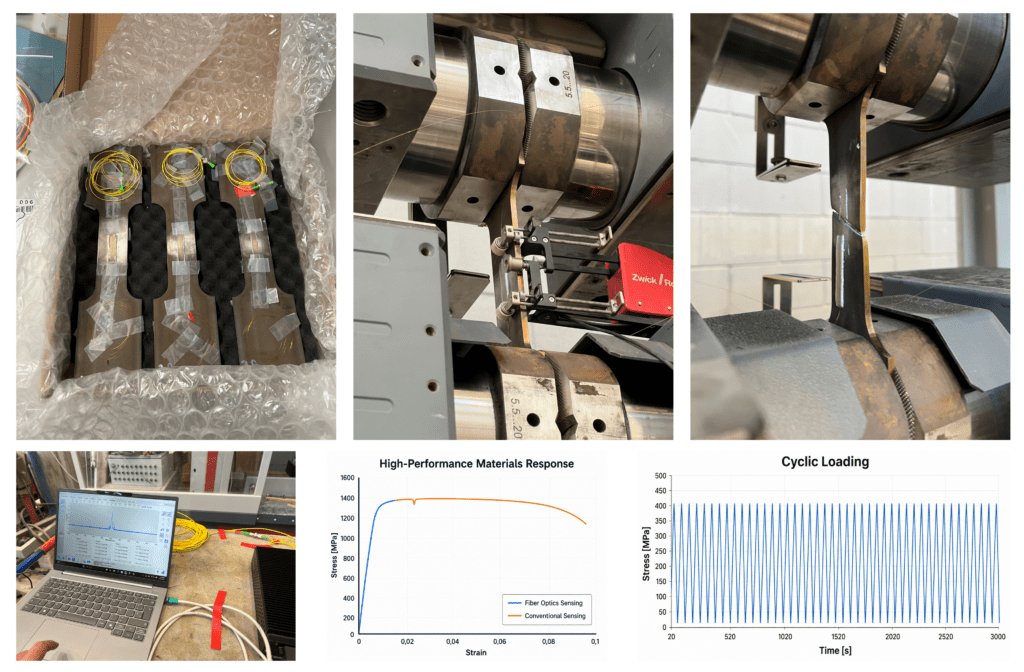
High-performance materials were mechanically characterized through tensile strength testing and cyclic loading. Conventional measurement methods were combined with fiber optics sensing technologies and ultra-high-speed interrogators to capture accurate data and analyze material response. The results enabled the validation of material performance, measurement reliability, and suitability for industrial and advanced monitoring applications.
In collaboration with Calsens, a company specialized in monitoring services for structures and processes, our group has played a key role in a project focused on the implementation and development of new techniques and strategies for advanced monitoring systems. Achieving sharp, accurate, and reliable procedures requires the use of high-performance materials capable of ensuring dependable measurements.
Our work focuses on the characterization of mechanical properties through tensile strength testing and cyclic loading, allowing for the determination of key strength parameters, material performance, and variability under different loading and unloading conditions.
This characterization was conducted using conventional strain and strength measurement methods, supported by high-capacity, high-precision universal testing machines, and complemented by fiber optic sensing technologies and interrogators with ultra-high data acquisition rates. These technologies make it possible to capture even the slightest variations in the material’s deformation field, providing a more detailed understanding of its mechanical response.
The results were processed and analyzed to characterize the material’s mechanical properties and validate the suitability of fiber optic sensing technologies for high-precision monitoring applications.